
What the Orientdig Spreadsheet is
The Orientdig Spreadsheet is the catalogue side of shopping through OrientDig. It is a browsable wall of product cards: a photograph, a name, the marketplace the item sits on, and one link per item. You pick things off it, and the link is what you hand to the agent.
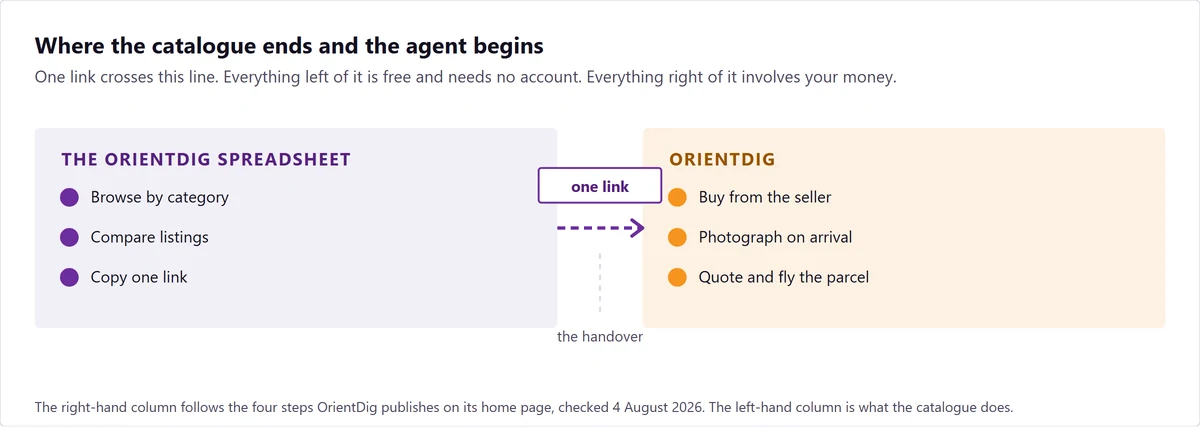
OrientDig and the Orientdig Spreadsheet are two different layers, and this is the thing people mix up. OrientDig is the agent: it buys from the Chinese seller, receives the parcel, photographs it and ships it to you. The Orientdig Spreadsheet is where you found the thing in the first place. The agent does not decide what goes on it, and the catalogue never touches your money.
Ours runs on the catalogue we maintain, which held more than 20,000 listings when we counted our own index in August 2026. The name is a leftover from years ago, when communities really did trade finds in shared files. Nothing is downloaded now and there is no document to open.
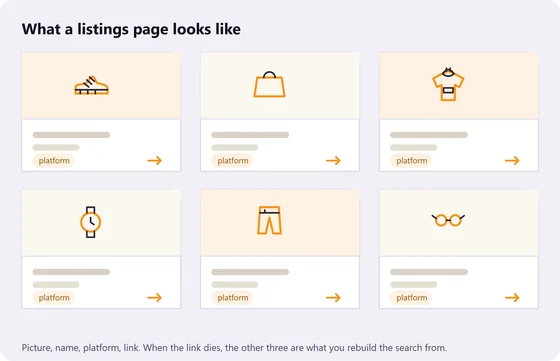
What is on an Orientdig Spreadsheet card
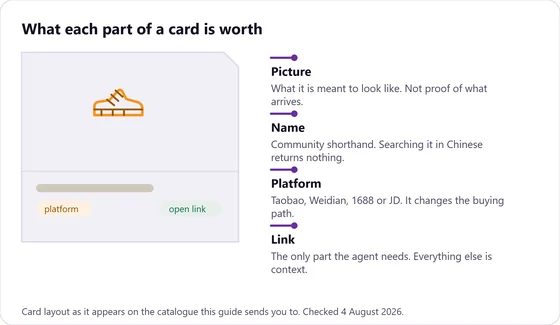
Four things, and only one of them is load bearing.
The picture tells you what the item is meant to look like, which is not the same as what will arrive. The name is usually community shorthand rather than the seller title, so typing it into a Chinese search box tends to return nothing. The platform mark tells you which buying path the item takes. The link is the part OrientDig needs, and the only part it needs.
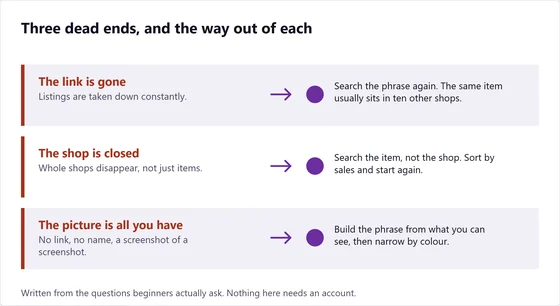
Knowing which part is decoration is most of the skill. It is also why the next page exists: when a card on the Orientdig Spreadsheet points at a listing that has been taken down, you rebuild the search from the picture and the platform, not from the name.
Why bother
Why start from the Orientdig Spreadsheet rather than a cold search
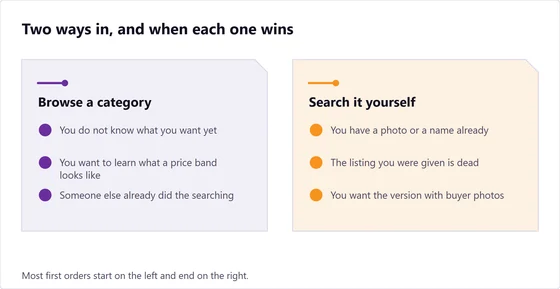
You can go straight to a Chinese marketplace and search. Plenty of people do. So why use the Spreadsheet at all? Three reasons, and the first one is the biggest.
Somebody already did the searching
Every card on the Orientdig Spreadsheet is the end product of the work this guide describes. Somebody found the item, checked it was the right one, and posted the link. Browsing is the fast path through all of that.
You learn what a price band looks like
Twenty minutes in one category teaches you what that category normally costs. After that, a listing well below the band reads as a warning rather than a bargain, which is the single most useful instinct to have before a first order.
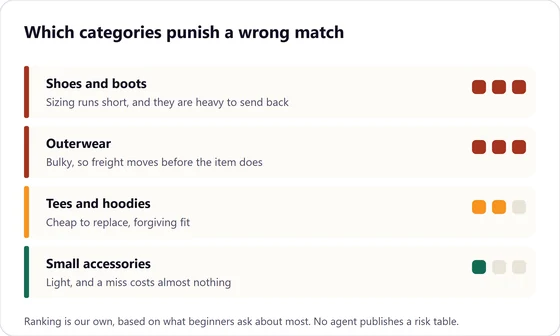
You find out which categories are worth shipping
Weight and bulk decide whether an item survives contact with freight. Browsing shows you quickly that a jacket and a keychain are not the same kind of purchase, long before you open a freight estimator.
Where the listings on the Orientdig Spreadsheet come from
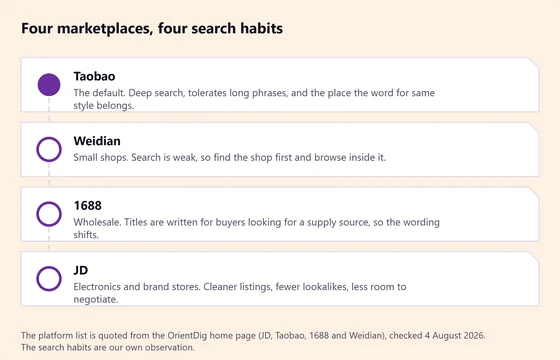
Every card points at one of the four marketplaces OrientDig names on its home page. Which one it sits on changes how you search for it later, so the platform mark is worth reading rather than skipping.
| Marketplace | What sits there | What it means for searching |
|---|---|---|
| Taobao | The broadest consumer catalogue, and most fashion finds. | Deep search that copes with long phrases. The default place to start. |
| Weidian | Small independent shops, often the only source for an item. | Weak search. Find the shop first, then browse inside it. |
| 1688 | Wholesale listings written for buyers sourcing in bulk. | Titles use supply-side wording, so the phrase you search shifts. |
| JD | Electronics and brand stores. | Cleaner listings and fewer lookalikes, so less checking needed. |
What the Orientdig Spreadsheet does and does not do
Worth being exact about, because the two columns get confused constantly and the confusion is what leads people to email the wrong party.
The Orientdig Spreadsheet
- Shows you what exists and what it looks like.
- Groups items by category so you can learn a price band.
- Hands you one live marketplace link per item.
- Costs nothing and needs no account.
OrientDig, not the Spreadsheet
- Buys the item from the Chinese seller.
- Holds it in a warehouse and photographs it.
- Quotes and charges international freight.
- Handles returns, refunds and anything to do with a parcel.
What it is not, and where it runs out
A card being on the Orientdig Spreadsheet means somebody found the item. It does not mean the seller is still trading, that this particular copy is the good one, or that anybody has inspected it. Nothing on the catalogue is sold by the catalogue, and no listing there holds stock.
It is also not exhaustive, and that is the honest limit. Plenty of items never appear on any listings site, and the ones that do go stale as sellers close. That gap is the entire reason this guide teaches searching: the catalogue is a head start, not a boundary.
Browse the Orientdig Spreadsheet by category
Six categories that suit a first order, with what makes each one easy or awkward. Every link here opens the live category it names.
T-shirts
Cheap, light and forgiving. The best category to make your first mistakes in.
Open the categoryCategory pageHoodies
Heavier than they look. Read the measurement table rather than the size letter.
Open the categoryCategory pageSneakers
Heavy and size critical. Worth it, but not as a first order.
Open the categoryCategory pageBags
No sizing risk. Hardware and lining decide whether it is the right one.
Open the categoryCategory pageWallets
Light and small, so freight barely registers. Easy to combine with other items.
Open the categoryCategory pageWatches
Read the movement description carefully. Photographs will not tell you what is inside.
Open the categoryHow to judge a finds site before you trust its links
Pick three cards at random, from three unrelated shelves, and click all of them. A single dead destination tells you what you need to know in well under a minute: sellers pull listings constantly, so a maintained list is one where somebody notices, and an abandoned one looks identical until you click.
Then look for dates. A copyright year in the footer is not a date. What counts is a date sitting next to the thing being claimed, so you can tell when somebody last opened the page they are describing. Everything on this site that quotes OrientDig carries the day we read it, and you should hold other sites to the same test.
Third, look for a sentence that costs the site money. Naming the categories where a wrong match is expensive, or admitting that a particular search is not worth attempting, are the sort of thing an affiliate page never writes. If nothing on the site has ever discouraged you from ordering, you are reading advertising that happens to be indexed.
