
Categories, and why the category changes the search
The old version of this site listed shoes, apparel, bags, accessories, electronics, perfume, other items and womenswear. Those are still the right groupings. What that list never said is that each group behaves differently once you start searching for something specific.
Sneakers are described by silhouette, so the words that work are shape words. Bags are described by material and hardware. Electronics are described by model number, which is the one case where latin characters survive into a Chinese listing title. Getting this right is most of the difference between forty results and four thousand.
Every link on this page opens that category of the Orientdig Spreadsheet on the catalogue, where the listings live.
Footwear
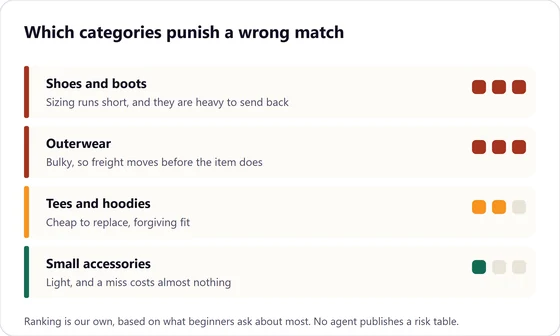
The heaviest thing most people order, and the category where a size mistake costs the most to fix.
Sneakers
Search by silhouette words rather than model names, then check the insole length in centimetres instead of the EU size.
Open the categoryCategory pageCasual shoes
Fewer lookalikes than sneakers, so the first page of results is usually usable.
Open the categoryCategory pageLeather shoes
Material wording matters. Listings distinguish full grain from coated leather and the price gap is large.
Open the categoryCategory pageSlippers
Light and cheap. A good way to fill space in a box you are already shipping.
Open the categoryApparel
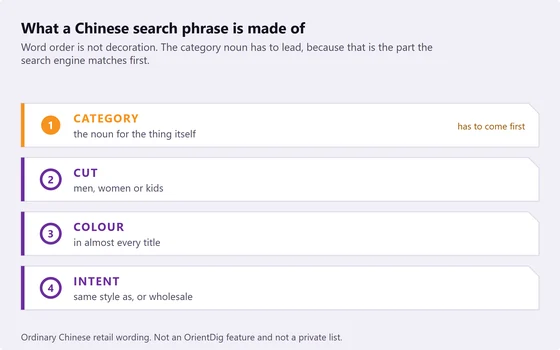
The category where measurements matter most, and where the search words are simplest. A category noun plus a cut plus a colour gets you most of the way there.
The trap is sizing. Chinese sizing runs smaller than European and much smaller than American, and the listing will tell you the actual chest and length in centimetres if you scroll far enough. Measure a garment you already own and compare. Do not trust a letter.
Ordering several sizes to try is a bad idea here, because you pay freight on all of them and returning from abroad is not practical.
Everyday clothing
Four groups that suit a first order, in rough order of how forgiving they are.
T-shirts
Light, cheap and hard to get wrong. Start here.
Open the categoryCategory pageHoodies
Warm and heavy. Check the weight before you add a second one.
Open the categoryCategory pageJackets
Bulky. One jacket can dominate the freight cost of a whole box.
Open the categoryCategory pageJeans
Measure the inside leg on a pair you own. Listings publish it.
Open the categoryBefore you order
What to check, by category
One thing per category that people wish they had checked. None of this is an OrientDig rule. It is our own list, written from the questions beginners ask.
| Category | The one thing to check | Why it bites |
|---|---|---|
| Sneakers | Insole length in centimetres | EU and US labels on marketplace listings are approximations, sometimes copied between shops. |
| Hoodies and jackets | Chest and length in centimetres | The cut runs slimmer than western equivalents even at the same nominal size. |
| Bags | Hardware finish and lining photos | Two listings using the same photo can ship different hardware. |
| Watches | How the movement is described | The single largest price driver, and invisible in photographs. |
| Electronics | Plug type and voltage | A charger that fits nothing is a heavy paperweight. |
| Perfume | Whether the route will carry it | Liquids and aerosols are restricted on many air services. |
Bags, accessories and the small stuff
Light categories, which is why they are the sensible thing to add to a box you are already sending.
Bags
No sizing risk at all. Judge it on hardware and lining.
Open the categoryCategory pageBackpacks
They take up box space without weighing much. Search by stated capacity, because photos of bags all look the same size.
Open the categoryCategory pageWallets
Almost weightless. Good filler for a parcel you are already sending.
Open the categoryCategory pageBelts
Sold by total length, not waist size. Measure a belt you own.
Open the categoryCategory pageEyewear
Lens quality is not visible in photos. Ask for close QC shots.
Open the categoryCategory pageJewelry
Plating thickness is the variable. Listings that name it are the better ones.
Open the categoryElectronics, perfume and the awkward categories
These are the categories where the marketplace matters most. JD carries brand-store electronics with cleaner listings, while Taobao carries far more variety and far more lookalikes. Model numbers survive into Chinese titles, so electronics are the one place where typing latin characters actually works.
Perfume, and anything else liquid, pressurised or battery powered, runs into the courier rather than the seller. Air services restrict those goods, the restriction is set by the carrier rather than by OrientDig, and the official estimator has a field for exactly this. Check it before you order rather than after.
How the freight estimate and the shipping choice work

Everything else
Four more categories worth knowing about, with the reason each one turns up in first orders.
Electronics
Search by model number. Check plug type and voltage before you order.
Open the categoryCategory pagePerfume
Restricted on many air services. Confirm the route carries it first.
Open the categoryCategory pageHeadphones
Battery powered, so the same route restrictions can apply.
Open the categoryCategory pageFigurines and collectibles
Light but bulky, so volume rather than weight sets the price.
Open the categoryHow to judge a listing before you pick the item
The operator publishes its own four stage summary, and stage one is the only one you control: select products from Chinese e-commerce websites and copy the link into the search box. Everything after that runs on whatever link you handed over, which is why the judging happens before the paste and not after.
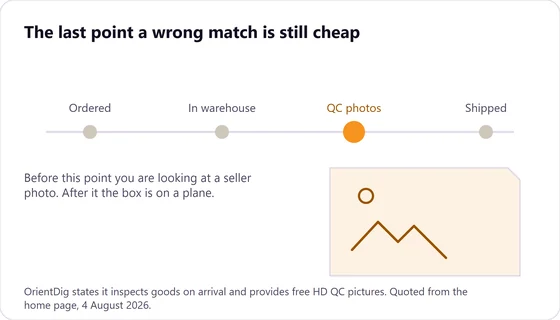
Order the checks by what cannot be undone. First, can it ship at all on the route you want, because liquids, powders, magnets and batteries are decided by the carrier rather than by the agent. Second, measurements as numbers rather than letter sizes. Third, buyer photographs, because the glossy renders at the top of a listing usually came from whoever makes the item and are pasted into every shop that resells it.
Only then look at price, and look at it as a spread rather than a number. A listing sitting well under the rest of the band is usually a different production run wearing the same photos. More correct searches end in the wrong parcel through that one door than through any other.