
What happens after you paste the link
Four stages, and OrientDig publishes all four on its home page. The wording below is ours. The sequence and the stated timings are theirs, captured on 4 August 2026.
Two of the stages cost money and they are not adjacent, which is the part that surprises people. You pay for the goods early and you pay for the flight later, once the parcel exists and can be weighed.
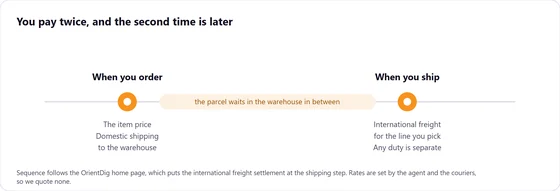
The four official stages
Quoted in sequence from the OrientDig home page. Each card below is the agent own illustration for that stage.
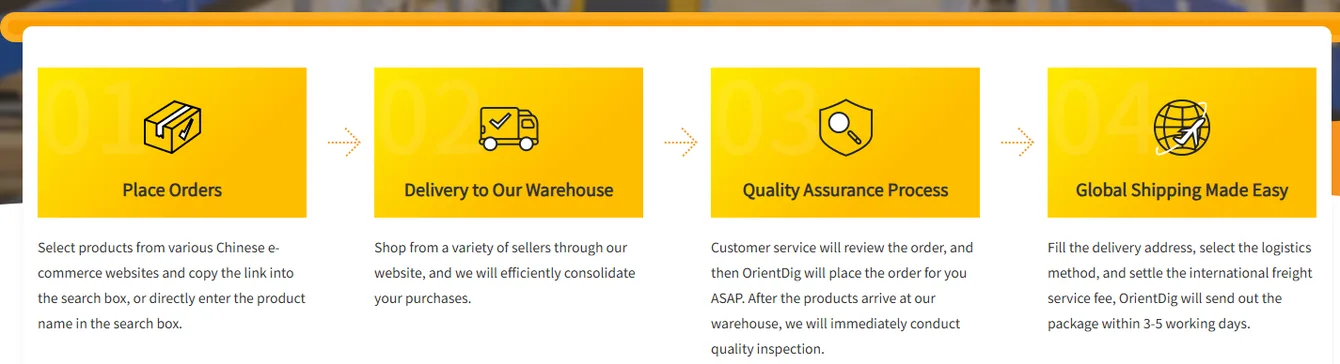
Place the order
OrientDig says to select products from various Chinese e-commerce websites and copy the link into the search box, or enter the product name directly. Customer service reviews the order and then places it with the seller.

Delivery to the warehouse
The seller ships domestically to the OrientDig warehouse. The official wording is that you shop from a variety of sellers through their site and they consolidate your purchases.

Quality assurance
OrientDig states that once products arrive at the warehouse it conducts a quality inspection immediately, and that free HD QC pictures are provided so you can check appearance and accessories.

Global shipping
You fill in the delivery address, select a logistics method and settle the international freight service fee. OrientDig says the package is sent out within 3 to 5 working days of that.

The freight estimate, and why it is an estimate
The official estimator asks for a destination and a weight in grams, both required, plus length, width and height in centimetres, plus a mail restriction field. Then it calculates.
The reason it cannot be exact before you order is that the weight and the box dimensions do not exist until the goods are packed. A hoodie has a listed weight and a real one, and the real one includes packaging.
The page also carries a notice that logistics services on non-proprietary lines are provided by third-party logistics providers, who adjust freight prices according to market conditions, and that OrientDig will notify if there is a price change. Two labels sit on that page reading free insurance and tax free. Those are the official page labels; we report that they are there and make no promise of our own about tax.

Consolidation, and what it is actually for
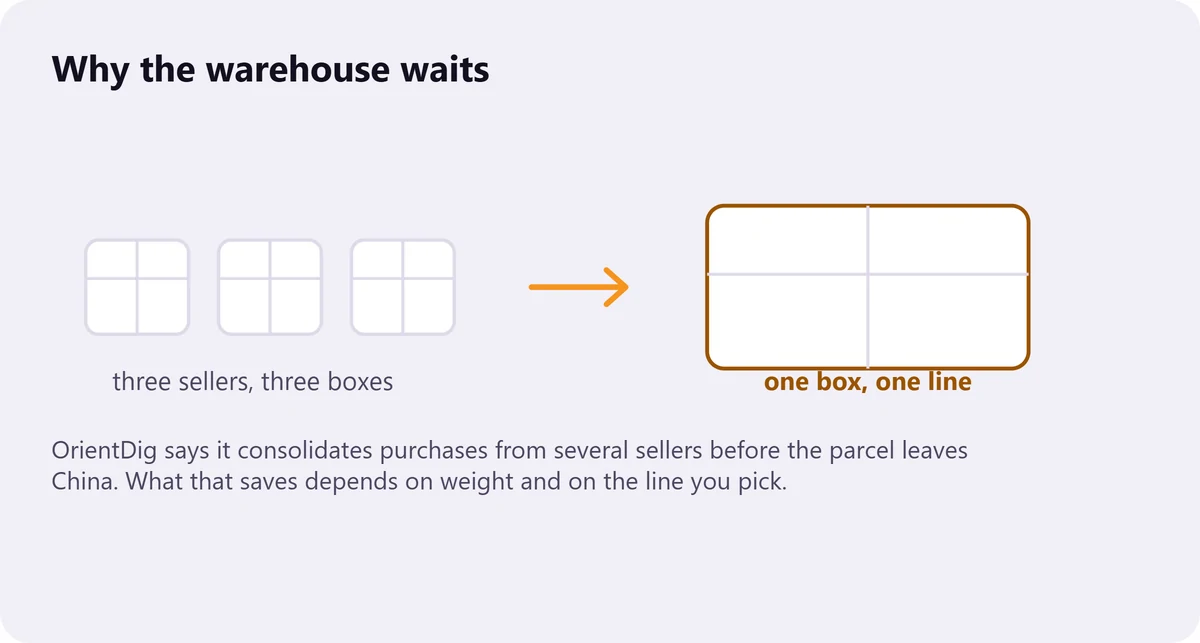
Consolidation means several items sitting in the warehouse leave in one box. It is the main reason an agent is worth using at all, because international freight punishes small parcels hardest. Four separate boxes means paying to move air four times.
The trade is time. Waiting for a slow seller holds up everything already in the warehouse, and the official service list mentions extra long free storage without publishing a number of days, so we do not quote one either.
Worth knowing
Three things people find out too late
All three come from the official pages rather than from us, and all three are easier to deal with before you order than after.
Returns have a window
The home page says that after you have placed an order, and before the item leaves the warehouse for international shipment, you may contact your order agent for a return or exchange. That is the window. Once it flies, a return means shipping it back across the world.
The DIY order form needs an account
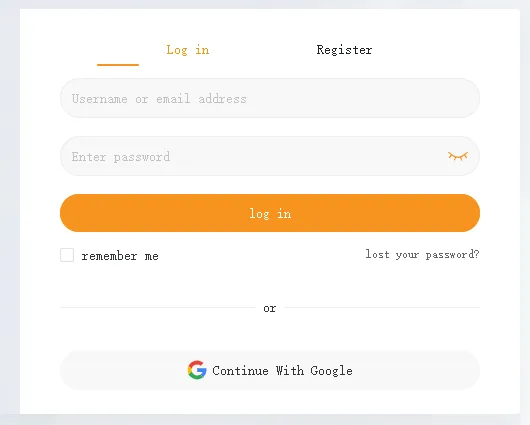
Requesting the DIY order page while signed out lands on a log in screen with a register tab. Browsing and freight estimates work without an account, the ordering form does not.
QC photographs are the real checkpoint
The photographs taken when goods reach the warehouse are the last cheap moment to catch a wrong item. Look at them properly rather than tapping confirm, because after this point every fix involves freight.
Who handles what
We are a guide. Everything involving money, parcels and returns sits with OrientDig, and knowing which side owns a problem saves a lot of time when something goes wrong.
| This | Who owns it | Where to go |
|---|---|---|
| Finding and confirming the item | You | The search method on this site |
| Buying from the seller | OrientDig | Your order agent, inside your account |
| Photographs on arrival | OrientDig | Your order page |
| Choosing a shipping method | You | The shipping step in your account |
| Freight price changes | The courier, passed on by OrientDig | The notice on the estimator page |
| Customs and duty on arrival | Your country customs authority | Your national customs guidance |
Who actually sets the freight price
The marks along the bottom of the OrientDig footer are worth a look before you compare quotes. The payment side and the carrier side are different businesses, and the agent sits between them rather than above them.
That matters when a quote looks wrong. A courier surcharge, a fuel adjustment or a route suspension is the carrier changing its own prices, and the estimator will show you the new number without explaining why it moved.

Before you order anything
Two official pages worth opening first, and one page here.

Run a freight estimate
Guess the weight generously and try two destinations. It is the fastest way to learn which categories are worth shipping at all.
Open the estimator
The DIY order page
Signed out, this lands on the log in screen. Worth registering before you have a cart full of links rather than after.
Open orientdig.com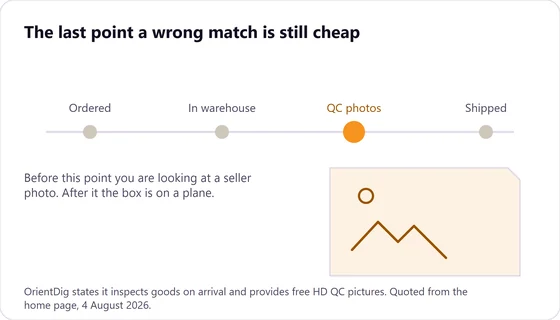
Know what the photographs are for
The warehouse photographs are your last cheap check. What people miss in them
The exchange rate you actually pay
The OrientDig header carries a language and currency switcher, and it is set to English and USD by default. That switcher is the first place the exchange rate shows up, because the listing you are reading is priced in yuan and the number you are shown is not.
Nothing on the site states which rate is used or when it is fixed. The estimator quotes freight, the fee page covers the service side, and the conversion sits quietly between the seller price and your card. That is not an accusation, it is simply a figure the operator does not publish, which means you should measure it rather than assume it.
Measuring takes a minute and is worth doing once. Note the yuan price on the marketplace listing, switch the header to USD, note what OrientDig shows for the same item, then work out what rate that implies and hold it against a live converter in the same minute. We print no number for the gap: it is not a published number, and a stale one here would cost you money directly.
